
South Korea battery industry started the first shot of growth! It's the biggest season ever
With the rapid growth of the global electric vehicle market, South Korea's battery industry is enjoying a peak season. LG New Energy and Samsung SDI recorded the highest operating performance in the third quarter of this year, and SK ON is expected to significantly reduce its loss margin.
This growth trend is expected to continue for some time.
LG New Energy announced on Wednesday that it posted an operating profit of 521.9 billion won in the third quarter, up from an operating loss of 372.8 billion won in the same period last year.
Sales nearly doubled to 7,648.2 billion won, up 89.9 percent year-on-year, and the company recorded the best operating profit.
Samsung SDI also recorded the highest earnings in the third quarter.
Samsung SDI's operating profit margin exceeded 10 percent, significantly improving profitability. For the first three quarters of this year, cumulative sales stood at 14,158.2 billion won and operating profit at 1,317.2 billion won, surpassing last year's full-year performance.
South Korean battery companies form Battery Alliance
The South Korean government has formed a "battery alliance" with Korean battery companies including LG New Energy, SK ON and Samsung SDI, aiming to overtake China and become the world's largest battery power by achieving a 40 percent global market share by 2030.
The government also unveiled a blueprint for domestic investment of 50 trillion won.
The battery industry is expected to invest 30.5 trillion won in facilities in Korea by 2030. The alliance plans to increase South Korea's domestic production capacity by 1.5 times from 39GWh last year to 60GWh by 2025.
Amid the growing demand for high-end electric vehicles, Korea has seen a surge in sales and profitability due to increased supply of high value-added products, increased sales of ESS batteries in the European market, and rising raw material prices.
Policy also has a great influence ON growth of battery industry in South Korea, the United States to the global battery supply chain broke the monopoly of the Chinese, the core material to cope with the inflation cuts to act in the United States, in battery industry of China is highly dependent ON the south Korean battery giant LG new energy and SK e.on, recently with battery raw materials companies such as Australia and Canada.
In terms of global EV battery share as of September this year, China's Ningdeo Times ranked first with 35.1 percent, followed by LG New Energy with 14.1 percent. After China's BYD (12.8 percent) and Japan's Panasonic (8.1 percent), SK ON (6.2 percent) and Samsung SDI (4.9 percent) ranked fifth and sixth, respectively.
More than 95% of Ningde Times' production capacity is sold to domestic major brand car enterprises, including domestic Tesla, NexteV, Xiaopeng Automobile, North and South Volkswagen, BMW Brilliance and other companies. In the global layout, Ningde times always lags behind LG new energy one step. As a global power battery giant, too localized competitiveness is a little insufficient.
However, LG NEV has a well-developed global strategy, especially in Europe and North America, where it has won a large number of orders. In terms of the number of power batteries installed outside China in the first seven months of this year, LG New Energy ranked first with 31.1GWh, while Yongdeoktimes ranked third.
Online shopping in South Korea grew 12.3 per cent in the third quarter from a year earlier
Online shopping volume in South Korea rose 12.3 percent year-on-year to 52.2574 trillion won (about 269 billion yuan) in the third quarter of this year, according to data released by the National Statistical Office (NSO) on Monday. Cultural and entertainment services increased 156.9 percent year on year, while tourism and mobility services increased 123.8 percent (* Data source: Yonhap)
The majority of online shoppers are young people aged between 20 and 39. Affected by the epidemic, the use rate of online shopping among middle-aged and elderly people has also increased significantly in recent years, and the use rate of online shopping among people aged between 40 and 60 has reached 59.3%.
South Korea has a good Internet infrastructure and a very high social media penetration rate (89.3%), which is 1.7 times the world average.
While the battery industry and e-commerce are booming in South Korea, manufacturing is not.
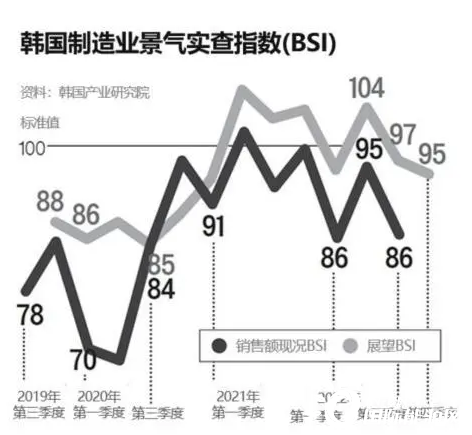
Data source: Korea Industrial Research Institute
According to the data, 70 percent of Korean manufacturers say they cannot sustain their business due to the rise in raw material prices due to the exchange rate. The outlook for South Korea's manufacturing economy in the fourth quarter of this year is gloomier than in the third quarter.
According to the survey, the main factors affecting business activities were the pressure on raw material costs due to the depreciation of the won and high inflation.
The BSI for the third quarter of this year was 86, down nine points from 95 in the second quarter. In addition, 74.8 percent of manufacturers predicted that the difficulties caused by the exchange rate, interest rate and inflation will continue until next year.
Disclaimer:
1. Some articles and pictures are from Yiou website;
2. Due to editing needs, there is no necessary connection between the text and the picture. It is only for readers' reference and does not represent the views of the platform, nor does it constitute investment advice or decision-making advice, nor does it provide material for any user transaction.
3. We have reproduced all the articles, pictures, audio video file information such as copyright belongs to the copyright shall belong to the original people, because of the original articles and pictures, etc can't contact and copyright, such as the author or editor that work should not be access to the Internet for everyone to browse, or should not be used free of charge, or involve copyright issues, please inform us in time, to take appropriate measures to quickly Avoid causing unnecessary economic losses or copyright disputes to both parties;
4. If this website infringes the intellectual property rights of media or individuals unintentionally, please contact us within 30 days after the publication of the article. We will delete the content as soon as possible, thank you.
;)