
Will "sharing" be the ultimate antidote to inefficient energy storage?
Energy storage can be regarded as the proudest appearance in this year's new energy track, but this year's performance of important or European households, while China's energy storage level, has been in the exploration of trial and error, near the end of the year, it will be the peak installation of photovoltaic power plants, see intelligent Science Research to talk about the phenomenon of energy storage in China:
Large reserve is the domestic focus, development mainly depends on it
In terms of the global pattern of energy storage, the energy storage market is mainly concentrated in three regions: the United States, China and Europe. The United States is the world's largest and fastest growing energy storage market, and China, the United States and Europe basically account for 80% of the global market share, forming the world's three poles. It was followed by Japan, South Korea and Australia. China and the United States have a lot of large storage, but Europe is different from China and the United States. Due to its energy structure, it is mainly household storage. Therefore, energy storage inverter companies have a very good performance this year, mainly due to the outbreak of the European optical storage market.
In terms of structure, China's energy storage power side accounts for 40%; The power grid side accounts for about 35%, and the remaining 25% is in the user side, and the user side is also dominated by industry and commerce, and the household storage is relatively small at present. Therefore, China still focuses on large-scale energy storage, that is, energy storage at the power supply and grid side, while large-capacity energy storage is rarely used at the user side. We still focus on the power supply side and the power grid side, among which the power supply side has a larger proportion.
However, China's current large reserves are mainly promoted by policies, including local government mandatory allocation of reserves; And the state department during the 14th Five-Year Plan period put forward the rigid requirements of the installed proportion of new energy, which is driving the underlying logic of the development of domestic large storage this year. The amount of domestic energy storage bidding this year has exceeded 12GW by October, and the installed amount of energy storage has increased significantly.
Is mandatory storage "One size fits all"? What is the landing effect
However, it is still difficult to implement the development of domestic energy storage, because the business model is still in the preliminary stage of formation. Since the second half of 2021, provincial policies on energy storage have been frequently introduced. Almost all provinces in China have issued the "14th Five-Year Plan" new energy storage planning or new energy configuration storage documents. A large number of policies are introduced intensively, but the actual implementation may be awkward, because there are too many subjects involved in energy storage, and it is difficult to coordinate the power grid, power supply and users. Therefore, even if the policy is promoted, it will face a lot of problems once it is implemented.
According to the review of the energy storage policy orientation of each province (incomplete statistics), it can be seen that the policy orientation of each province to scenery storage distribution. From the policy of this year, the average requirement of storage distribution ratio of each province is about 10%, and the interval is between 5% and 20%.
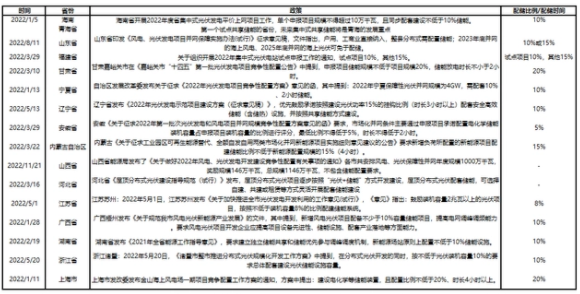
(See Wise Research Mapping)
Although the mandatory storage policy promotes the installed development of energy storage, the actual effect may not be good, because the mandatory storage policy regards the configuration of new energy storage as the threshold of grid-connection, but lacks supervision on its real operation effect, resulting in low utilization rate of power supply side storage. In addition, the "one-size-fits-all" policy is not conducive to the healthy development of the industry, because the administrative order to promote the distribution and storage, the actual implementation will find that the component price is high, other costs are high, no profit, terminal distribution and storage enthusiasm is not strong. Moreover, with the increasing proportion of wind power and photovoltaic power generation, it is urgent for the policy formulation to meet the needs of the real development.
Will shared storage become an energy storage ecological Trend?
Shared energy storage is the result of continuous policy optimization. Shared energy storage is a business model of independent energy storage, which can be understood as a one-to-many mode. That is to say, as the owner of new energy, you still have to fulfill the mandatory distribution obligation, but you can choose to rent other people's energy storage station. In fact, it saves the large expenditure of self-investment and converts the large expenditure into small capital, which is beneficial to the internal rate of return of new energy investors. It is good for investors of new energy power stations and also conducive to the landing of distribution and storage targets.
From the perspective of domestic provincial policies, shared energy storage was first piloted in Qinghai province, and now Shandong, Hunan, Zhejiang, Shanxi and other places have successively taken shared energy storage as an important direction in the construction of energy storage power stations.
In addition to Qinghai Province, Shandong Province is the first country to explore shared energy storage, and it is also the key area of shared energy storage experiment. At present, the model of Shandong province is also promoted in many provinces. The income sources of shared energy storage include capacity subsidies, new energy rent payment, peak-valley spread income, and the internal rate of return can be maintained at about 8%.
In addition to Shandong, other provinces are not lagging behind. Shanxi leads the country in the proportion of new energy, accounting for about 35% of the installed capacity. On November 21, the Energy Bureau of Shanxi Province issued the Notice on Matters Related to the Competitive Allocation of wind power and photovoltaic Power Generation Development and Construction in 2022. The award scale is 1.46 million kW; The competitive configuration plan released by Shanxi Province does not include storage configuration requirements. Different from the shared energy storage revenue model of Shandong Province, Shanxi's revenue sources are mainly spot spread and primary frequency modulation service. As can be seen from the policy, the energy storage mechanism in Shandong and Shanxi has become more market-oriented.
According to the research of Jianzhi, from the perspective of energy storage policies introduced by provinces, shared energy storage has become a new energy storage mode that has been piloted by provinces, which can be said to bring light to the dilemma of poor utilization of energy storage. However, there is also a risk point about how reproducible it is, and shared energy storage is only applicable to the power supply side and the power grid side, not the user side. However, according to Jianzhi research, shared energy storage may not be the end of the road for energy storage development, because the market mechanism will continue to optimize more economical and efficient models, but at least compared to the one-size-fits-all policy promotion, shared energy storage can be said to be a very good step.
Disclaimer:
1. Some articles, pictures source: Wall Street Insight;
2. Due to editing needs, there is no necessary connection between the text and the picture. It is only for readers' reference and does not represent the views of the platform, nor does it constitute investment advice or decision-making advice, nor does it provide material for any user transaction.
3. We reprint all articles, pictures, audio and video files and other materials copyright copyright belongs to the original owner, because the contents of the non-original articles and pictures can not be contacted with the copyright owner, if the original author or editor thinks that the work is not suitable for browsing online, or should not be used free of charge, or involved in copyright issues, please inform us in time, in order to quickly take appropriate measures, Avoid causing unnecessary economic losses or copyright disputes to both parties;
4. If this website infringes the intellectual property rights of media or individuals unintentionally, please contact us within 30 days after the publication of the article. We will delete the content as soon as possible, thank you.
使用微信掃一掃"});)