
The trend! The positive changes of domestic energy storage can be seen from the evolution of income
The positive changes in domestic energy storage this year are first reflected in the rapid growth of demand. According to CNESA statistics, 149 new energy storage projects (including planning, construction and operation) were added in September, with a total scale of 13.1GW/35.1GWh, including 12.9GW / 34.5GWh planned/under construction projects.
The power grid side accounts for 64%, up to 8.4GW/19.0GWh, all of which are independent energy storage. User side industry and commerce account for 98%. Independent energy storage accounts for more than 60% of the business model is widely recognized by the market, the general trend. Industry and commerce lead the user side project, the future increment can be expected.
The average price of EPC remained at a high level above 1.8 yuan /Wh for a long time, and even exceeded 2 yuan /Wh in September. As prices go up, the profitability of the energy storage industry chain continues to improve. Economically raise the unit price of independent storage. According to statistics, the average price of independent energy storage from July to September was 1.90 yuan, 2.04 yuan, 1.98 yuan /Wh, about 0.3-0.4 yuan /Wh higher than the average price of new energy forced energy storage in the same period, which opened the profit space for the industrial chain. Trend Energy storage integrates all kinds of data. This paper briefly introduces the independent energy storage revenue model and revenue analysis.
Independent energy storage revenue models can be divided into four types
Independent energy storage refers to independent energy storage power station, whose independence is reflected in that it can directly sign grid-connected scheduling agreement with power dispatching agency as an independent subject, and is not restricted by location.
Independent energy storage revenue models can be roughly divided into the following four types: shared leasing, spot arbitrage, auxiliary services, and capacity electricity price.
Share lease
Shared energy storage is a business model that is funded, operated and maintained by a third party or vendor. As a lessor, it rents out the power and capacity of the energy storage system to target users in the form of commodities, adhering to the principle of "whoever benefits pays" and collecting rent from the lessee.
Users can enjoy energy storage charging and discharging power within the service period to meet their own energy supply demand, without the need to build an independent energy storage station, which greatly reduces the original capital investment, and fully considers the cost and reasonable benefits of energy storage construction.
Graph: Shared storage allows new energy owners to avoid one-time capital expenditures
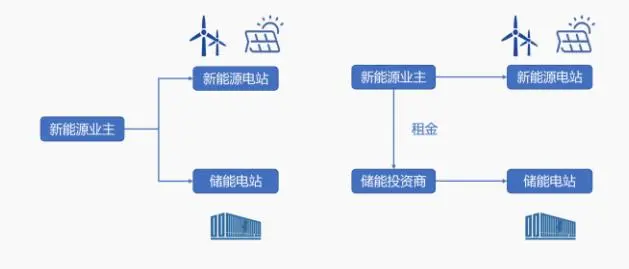
Figure: Centralized scheduling management of shared energy storage
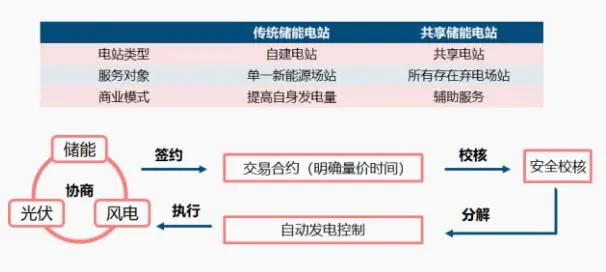
For shared energy storage investors, the cost of capacity leasing is a stable source of income, generally ranging from 250-350 yuan /kW/ year in China. The capacity leasing cost of 100MW shared energy storage power station can reach 25-35 million yuan/year.
Spot arbitrage
The Notice on Further Promoting the Participation of New Energy Storage in the Power Market and Dispatching issued by the National Development and Reform Commission and the Energy Administration also clearly points out that for the independent energy storage power station to supply electricity to the grid, the corresponding charging amount will not bear the transmission and distribution price, government funds and surcharges, which will reduce the electricity cost of the energy storage power station by about 0.1-0.2 yuan/KWH. Policies to improve the economy of energy storage power stations and promote the rapid development of the domestic energy storage industry.
Figure: Spot market, day ahead, real time (balance) two markets
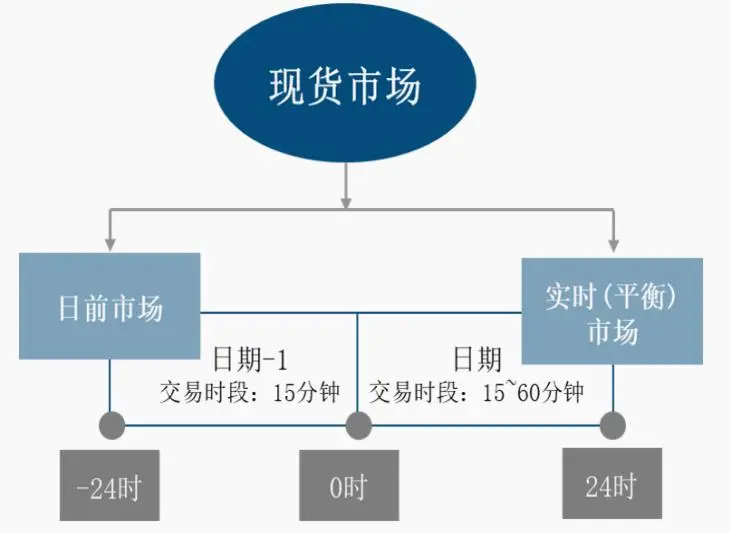
Shandong was the first province to independently store energy and enter the spot power market. According to "Shandong Power Spot Market Trading Rules (Trial)" (Version 1.0, 2022), independent energy storage stations can choose to participate in FM market or electricity market. In the electric energy market, the energy storage power station "does not quote", and priority is given to clearing when the safe and stable operation of the power grid and the consumption of new energy are satisfied. In the FM market, the energy storage station must compete with the generator set.
The peak-valley price difference in Shandong electric power spot market is large, creating greater profit space for independent energy storage power stations. Taking the daily data of settlement trial operation in April as an example, the average price difference of Shandong real-time power spot market is 932.15 yuan /MWh, among which the highest price difference is 1380 yuan /MWh; The lowest spread was 439.93 yuan /MWh on April 4. The phenomenon of high price spread creates more profit room for energy storage.
Taking the lowest price difference on April 4 as an example, the highest electricity price appeared around 6:00, 18:00 and 24:00, while the peak photovoltaic output was about -80 yuan /MWh between 9:00-15:00. This means that on April 4, the lowest price difference in April, the independent energy storage station will store electricity at the peak of photovoltaic output (9~15 hours) and discharge it between 17~19 hours, so as to obtain a profit of more than 300 yuan /MWh.
Ancillary service equipment
In August 2021, the National Energy Administration officially issued the new version of the Regulations on the Management of Grid-Connected Entities and the Administrative Measures for Auxiliary Services of the Power System (referred to as the new two Regulations), which officially recognized new energy storage (including electrochemistry, compressed air, flywheel, liquid flow, etc.). .). As an independent grid-connected entity, it needs to abide by the relevant regulations of safe and stable operation, and can also participate in the auxiliary service market for profit.
In June 2022, the Southern Regulatory Bureau of the National Energy Administration issued a new version of the "Two Regulations" in the Southern region, taking independent energy storage stations as the new main body into the management of the "Two regulations" in the Southern region, further improving the compensation standard of independent energy storage, improving the profit mechanism of independent energy storage, and raising the entry threshold of independent energy storage stations.
At present, the common auxiliary service forms of new energy storage mainly include peak regulation and frequency modulation (including primary frequency modulation and secondary frequency modulation). The specific benefits vary from province to province, but mainly peak power, the price from Shandong's 0.15 yuan/KWH to Ningxia's 0.8 yuan/KWH. FM is mainly based on FM range compensation. FM compensation of 0.1-15 yuan /MW is carried out according to how many units (PCS) respond to AGC FM instructions.
Capacity of electricity
At present, only Shandong has given the electricity price of electrochemical energy storage capacity according to the thermal power standard after starting the trial operation in the spot market. Similar to the role of stored standby thermal power in the system, the utilization hours are highly uncertain, and it is difficult to maintain economy only by electricity price, so it needs to "cover" the capacity electricity price.
However, unlike power generation and thermal power generation, electrochemical power stations are easy to build and have excellent regulatory performance. The national policy direction is to push electrochemical energy storage to the power market for profit as far as possible, and the capacity price is only a means to "guarantee the bottom" of electrochemical energy storage revenue.
Yield analysis: Can support 8%-10% of the project capital
Since the first independent (shared) energy storage project was launched in Qinghai Province, it has experienced policy and practice exploration in Shandong, Shanxi, Gansu and other provinces and at the national level. There are more than 14 provinces with initial independent energy storage policies, with different income models, but they fall into four categories: shared leasing, spot arbitrage, auxiliary services and capacity electricity price. Look at the revenue patterns in Shandong and Shanxi.
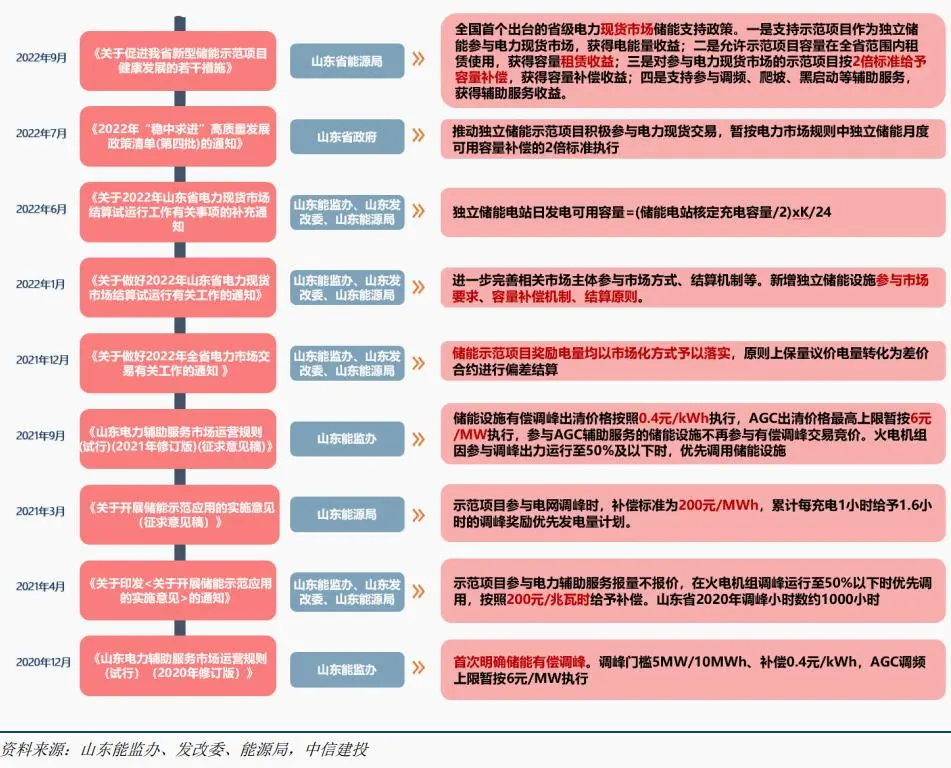
Shandong: Independent energy storage pioneer, spot + lease + capacity electricity price model
At present, Shandong independent energy storage power stations enjoy three income modes: shared leasing, spot arbitrage and capacity price compensation. According to Shandong Electric Power Engineering Consulting Institute, under this model, a 100MW/200MWh independent energy storage station is expected to gain spot arbitrage of about 20 million yuan, shared lease of about 30 million yuan, and capacity electricity price of about 6 million yuan. With a total investment of about 450 million yuan and a financing cost of 4.65 percent, the project is expected to achieve a return on capital of more than 8 percent.
Figure: Policy changes of Shandong independent energy storage support
Shanxi: First start FM auxiliary service, high rate of return
Shanxi is one of the first eight power spot trading demonstration provinces in China. It has been trading on the spot power market since the end of 2018 and operated for three months in 2019 and 2020 respectively. The spot trading policy will be implemented from April 1, 2021. It is the pilot province with the longest running time of spot trading. After several years of operation, the spot trading market in Shanxi Province has gradually matured and the policy is basically stable, among which the detailed rules of independent energy storage participating in spot trading are clearly defined.
Electricity price provides a "bottom" for domestic independent energy storage projects. Many provinces, represented by Shandong, have conducted a lot of beneficial exploration on the income mechanism and business model of independent energy storage. It is expected that the profit model of spot trading + shared leasing + auxiliary service + capacity electricity price will permeate the independent (shared) energy storage power stations of our country.
The increasing abundance of revenue mechanisms will significantly increase the profitability of independent energy storage projects. Only when energy storage projects are economical, can they create enough profit space and profit elasticity for the supply chain, and finally bring the volume of performance.
Disclaimer:
1. Some articles and pictures come from the Internet;
2. Due to editing needs, there is no necessary connection between the text and the picture. It is only for readers' reference and does not represent the views of the platform, nor does it constitute investment advice or decision-making advice, nor does it provide material for any user transaction.
3. We have reproduced all the articles, pictures, audio video file information such as copyright belongs to the copyright shall belong to the original people, because of the original articles and pictures, etc can't contact and copyright, such as the author or editor that work should not be access to the Internet for everyone to browse, or should not be used free of charge, or involve copyright issues, please inform us in time, to take appropriate measures to quickly Avoid causing unnecessary economic losses or copyright disputes to both parties;
4. If this website infringes the intellectual property rights of media or individuals unintentionally, please contact us within 30 days after the publication of the article. We will delete the content as soon as possible, thank you.

;)