
New energy storage, pumped storage, new energy batteries become the focus! Planning for the developm
Starting from mid-January 2023, 31 provinces and municipalities across the country issued government work reports for 2023, clarifying the priorities for the work of the provincial governments in 2023 and the next five years. Among them, new energy systems, new energy storage, pumped storage, charge and storage in the source network, multi-energy complementarity, and new energy batteries are also included in the provincial priorities in 2023.
Development priorities of new energy storage in 22 provinces and cities were determined
In the 2022 Government Work report, 22 provinces and municipalities -- Guangdong, Fujian, Yunnan, Sichuan, Chongqing, Zhejiang, Shaanxi, Shanxi, Shandong, Qinghai, Ningxia, Liaoning, Jilin, Xinjiang, Jiangxi, Henan, Hunan, Guizhou, Hubei, Gansu, Inner Mongolia and Tibet -- identified priorities for the development of new energy storage.
In terms of new energy storage projects, Chongqing will accelerate the development of shale gas in key blocks and implement a number of new energy storage demonstration projects. Shandong requires the completion of Qingyun Phase II of the Three Gorges project and the Dongying new energy storage project of China Resources Finance.
In terms of the integration of source, grid, charge and storage, Yunnan is required to accelerate the development of clean energy such as photovoltaic energy, implement a number of demonstration projects of source, grid, charge and storage, improve the pricing mechanism of new energy and storage, and carry out spot power pilot projects. Qinghai, on the other hand, adheres to the integration of source, network, charge and storage, builds a multi-synergistic and efficient energy storage system, and actively builds a national demonstration zone for energy storage. Jilin has proposed to build a pilot project integrating "source, network, load and storage" to attract large power users to settle in Jilin.
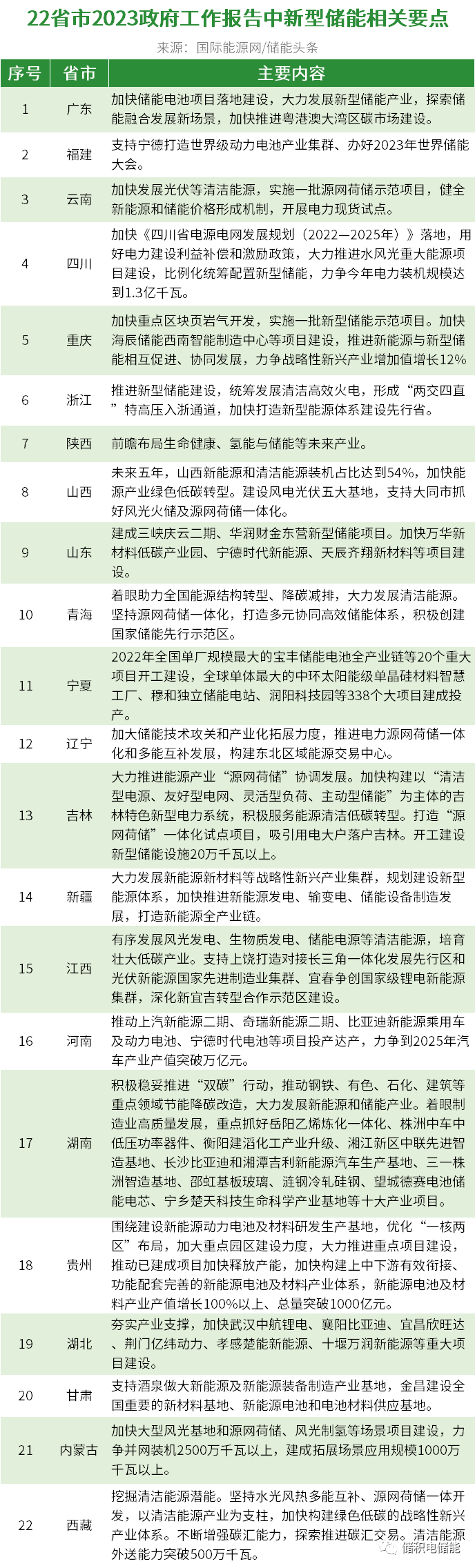
In terms of new energy batteries, Guangdong proposed to accelerate the construction of energy storage battery projects; Henan explicitly required to promote SAIC New Energy Phase II, Chery New Energy Phase II, BYD new energy passenger cars and power batteries, Ningde generation batteries and other projects into production; Hubei will speed up the construction of new energy battery projects such as Wuhan Aviation China Lithium Power, Xiangyang BYD, Yichang Xinwang Da, Jingmen Yiwei Power, Xiaogan Chuneng New Energy, Shiyan Wanrun New Energy.
It is worth noting that Guizhou will focus on the construction of R&D and production bases for new energy power batteries and materials, optimize the layout of "one nuclear and two zones", strengthen the construction of key parks, vigorously promote the construction of key projects, accelerate the release of production capacity of existing projects, and accelerate the construction of a new energy battery and material industry system that effectively connects the upper, middle and lower reaches with complete functional support. The output value of the new-energy battery and material industries increased by more than 100%, with the total value exceeding 100 billion yuan.
picture
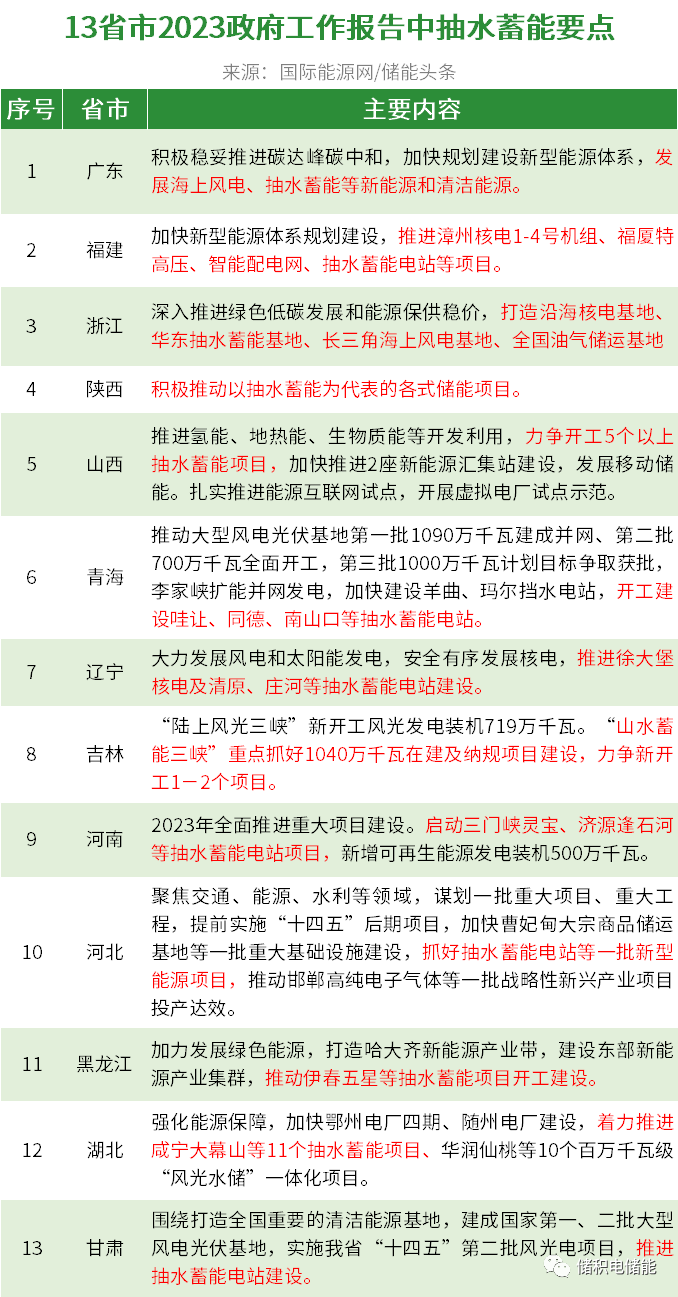
13 provinces and cities mentioned pumped storage
In the government Work Report for 2022, 13 provinces -- Guangdong, Fujian, Zhejiang, Shaanxi, Shanxi, Qinghai, Liaoning, Jilin, Henan, Hebei, Heilongjiang, Hubei and Gansu -- mentioned pumped storage.
picture
22 to support the construction of electric charging and replacement and new energy vehicles
As an important new energy infrastructure, the construction of electric charging and replacing facilities has attracted attention from all over the world. In 2023, 22 places support the construction of electric charging and replacement and new energy vehicles:
Guangdong: Cultivate and strengthen strategic emerging industrial clusters such as biomedicine, integrated circuit, intelligent networking and new-energy vehicles. We will support large-scale consumption of housing improvements, new-energy vehicles, and green smart home appliances.
Fujian: Support the consumption of housing improvement, new-energy vehicles and elderly care services, increase the bulk consumption of household appliances, furniture and home decoration, and expand the consumption of hot spots such as upgrading information and green.
Yunnan: Support consumption in housing improvement, new-energy vehicles, elderly care services, education, medical care, culture and sports services, boost bulk consumption and strengthen new-type consumption.
Sichuan: Implement the "Electric Sichuan" action plan, accelerate the construction of electric charging and replacing facilities, and build Chengdu-Chongqing hydrogen corridor, electric corridor and Zhixing Corridor.
Chongqing: To build two trillion-level industrial clusters of intelligent networked new-energy vehicles and electronic information manufacturing, strengthen strategic emerging industries, further implement the development plan of world-class intelligent networked new-energy vehicles industry cluster, accelerate the construction of Changan, Seris and other new-energy vehicles and supporting projects, integrate the planning, construction and operation of "storage and parking" facilities, and build a complete industrial ecological chain.
Shaanxi: Accelerate the development of Xi 'an integrated circuit, new energy vehicles, photovoltaic equipment, Baoji advanced structural materials industrial cluster.
Shanxi: Built 30,000 public charging piles.
Shandong: Accelerate the promotion of hydrogen fuel cell vehicles, integrate resources such as lithium electricity, power system and vehicle manufacturing, and form competitive advantages in the field of new energy vehicles as soon as possible.
Qinghai: Rational distribution and construction of new-energy vehicle charging piles and power changing stations.
Ningxia: Actively supported the expansion of basic consumption of new-energy vehicles, accelerated the improvement of large circulation and smooth micro-circulation, and built a number of blocked roads, parking Spaces, charging piles, etc.
Liaoning: Cultivate new consumption growth points such as new-energy vehicles, green smart household appliances and smart wearables.
Guizhou: Promote electric replacement of public service vehicles, increase and update new-energy buses and taxis account for no less than 80%, and realize full coverage of charging facilities in service areas of operating expressways.
Beijing: China will expand its presence in emerging sectors such as satellite Internet and hydrogen energy, and accelerate the construction of high-quality projects for new energy vehicles. New energy vehicles will be promoted in key industries such as public transportation, sanitation and leasing to continuously improve air quality.
Shanghai: Promote the construction of electric vehicle charging and replacement facilities, and accelerate the construction of a new electric power system.
Tianjin: 2,000 new public charging piles.
Hebei: Support green and low-carbon consumption such as new-energy vehicles, and promote the integration of online and offline consumption.
Heilongjiang: Accelerate the layout of charging infrastructure to stimulate consumption demand for new-energy vehicles.
Jiangsu: Support new energy vehicles, home appliances and other bulk consumption.
Anhui: Support consumption of new energy vehicles and elderly care services. Highlight the "core and vehicle linkage" to promote the ecological construction of the whole industry of new energy vehicles and intelligent networked vehicles.
Hubei: Vigorously support housing improvement, new energy vehicles, green household appliances and other bulk consumption.
Guangxi: Improved the charging and changing network of cars along highways, promoted charging facilities into communities and towns, and added more than 15,000 charging piles.
Hainan: Major projects of new energy vehicles were put into operation.
Disclaimer:
1. Some articles and pictures are from energy storage headlines;
2. Due to editing needs, there is no necessary connection between the text and the picture. It is only for readers' reference, and does not represent the views of the platform, nor does it constitute investment advice or decision-making advice, nor does it provide material for any user transaction.
3. All articles, pictures, audio and video files reproduced by us are copyrighted to the original owner. Because the contents of non-original articles and pictures cannot be contacted by the copyright owner. Avoid causing unnecessary economic losses or copyright disputes to both parties;
4. If this website infringes the intellectual property rights of media or individuals unintentionally, please contact us within 30 days after the publication of the article. We will delete the content as soon as possible, thank you.

;)